Food for the Soul: A Kitchen Table, a Ceilidh, and the Stories That Feed Us

Updated: Oct 14
There is a particular kind of hunger that no meal can satisfy.
It sits somewhere behind the ribs, just under the sternum, in that quiet place where memory and meaning tend to gather like old friends who never quite leave. It is not a loud hunger. It does not demand. It waits. Patient. Persistent. And every now and then, if you’re lucky, it is fed.
I was reminded of that hunger in Halifax.
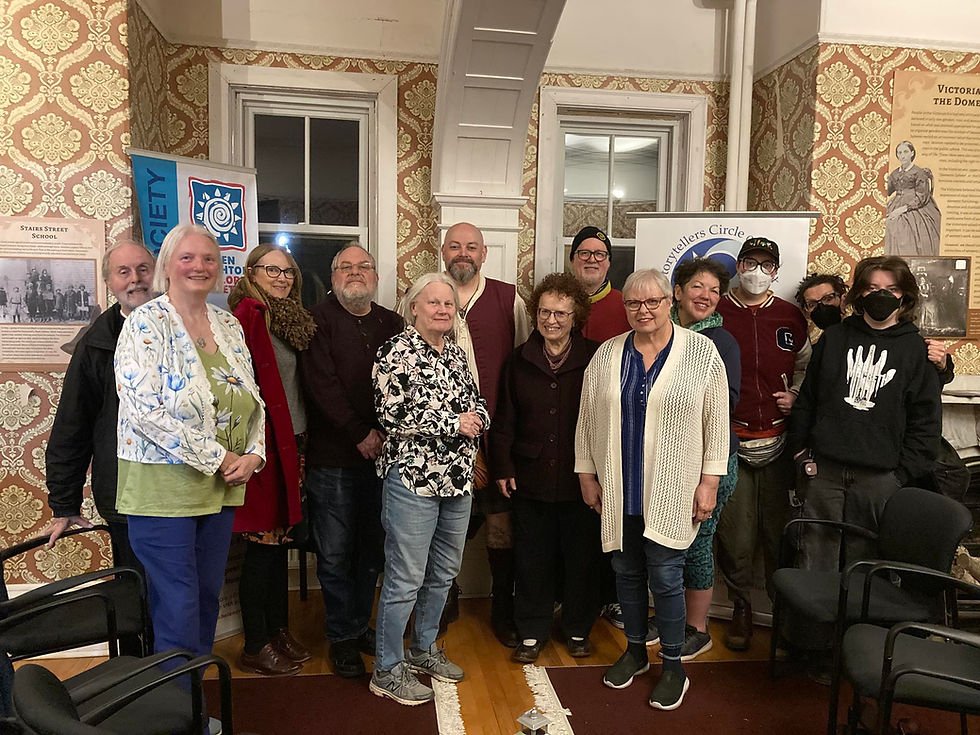
Or perhaps more accurately, in Dartmouth, in a house that has held more stories than most of us will ever tell in a lifetime. Evergreen House, home to the Dartmouth Heritage Museum, once belonging to folklorist Helen Creighton, a woman who understood, long before many of us did, that stories are not luxuries. They are sustenance.
I had been invited to work with the Storytellers Circle of Halifax, to deliver a workshop called The Modern Ceilidh and to share an evening of Scottish tales as their guest teller. A simple enough premise. A professional engagement. A gathering of voices. A few stories exchanged.
But that’s the thing about stories, they rarely stay within the boundaries we set for them.
They spill.
The journey to a telling is always a curious thing.
You arrive carrying your stories like carefully wrapped parcels. Polished. Practiced. Ready. You know where the beats land, where the laughter might come, where the silence will settle like a held breath. There is comfort in that preparation. A sense of control.
And then you step into a room.
And the room breathes back.
Evergreen House is not just a venue, it is a presence. The kind of place where the walls seem to listen. Where the floorboards remember footsteps long gone. You can feel it the moment you enter: the weight of voices that have passed through, the echoes of songs and tales gathered like dust motes in the corners of the light.
Standing there, preparing to deliver The Modern Ceilidh, I found myself thinking not about performance, but about lineage. About the long, unbroken thread of storytelling that stretches from peat fires in Scotland to kitchens in Nova Scotia, carried across oceans in memory and voice.
The workshop itself was alive in the way only a room full of storytellers can be. Not because of me, never because of me, but because of the people in it. The willingness to share. The quiet bravery it takes to speak something personal into a room. The understanding, spoken or not, that what we are doing matters.
We spoke about structure. About voice. About the balance between tradition and innovation. But beneath all of that, there was something else happening, a recognition. A remembering.
Storytelling is not something we do.
It is something we are.
The following night, the telling shifted again.
Scottish tales have a rhythm to them. A cadence shaped by land and language, by wind over hills and water against stone. When you tell them far from where they were born, something interesting happens, they don’t lose their power. They adapt. They find new footing.
And as I stood there, sharing those stories, I could feel the room leaning in, not just to me, but to the stories themselves. To the familiar threads woven into unfamiliar cloth. To the echoes of something deeply human.
There is a particular joy in being listened to.
Not the polite kind. Not the distracted nodding of modern attention. But real listening, the kind that holds you steady, that meets your eyes, that walks beside you through the story rather than watching from a distance.
It is rare.
And when it happens, it feels like being seen.
But if the telling at Evergreen House fed something in me, it was what came before that truly fueled the fire.
Because stories, as it turns out, do not end when the audience leaves.
They surround you, wherever you go.
I was hosted during my time in Dartmouth by Elinor and Ron.
Now, you can measure hospitality in many ways. In the comfort of a bed. In the generosity of meals. In the ease of conversation.
Or you can measure it in stories.
From the moment I stepped into their home, there was a sense of warmth that went beyond kindness. It was not performative. It was not curated. It simply was. The kind of warmth that says: You are welcome here. Not as a guest, but as part of the room.
And yes, the meals were extraordinary. The kind that make you pause between bites, not out of politeness, but out of genuine appreciation. But more than that, it was the conversation that lingered.
Stories, slipping in and out of the spaces between sentences.
Shared not as performances, but as offerings.
I had plans, you see.
Carefully laid, neatly scheduled plans.
I was going to explore Dartmouth and downtown Halifax. Capture moments. Record stories in meaningful locations. Create content, tidy, digestible pieces of storytelling designed for the digital world.
It all made sense.
It was productive. Efficient. Strategic.
And it lasted approximately… a day.
Because on the final day of my trip, something far more compelling happened.
We sat at the kitchen table.
Coffee was poured. Then poured again. And again.
And what began as conversation became something else entirely.
Seven hours.
Seven hours of stories.
Not planned. Not performed. Not recorded. Just… shared.
There is a magic that happens around a kitchen table.
It is not bound by structure. It does not require an audience. It does not ask for perfection. It invites honesty. It encourages wandering. It allows stories to breathe in ways they often cannot on a stage.
We spoke of everything.
Of childhood and memory. Of travel and loss. Of joy and absurdity. Of the strange, intricate ways our lives weave together through narrative. One story would spark another. A detail would unlock a memory. A laugh would give way to something quieter, something deeper.
Time, as it often does in the presence of good storytelling, became irrelevant.
There was no need to check a clock.
No urgency to move on.
Just the steady, unfolding rhythm of human connection.
At some point, though I couldn’t tell you exactly when, I realized something.
This was it.
This was the thing.
Not the carefully crafted content I had planned to capture. Not the polished stories delivered in a formal setting. Not the measurable outputs or shareable clips.
This.
This delightful, meandering, deeply human exchange of stories.
This was the heart of it all.
We live in a time where storytelling has become, in many ways, transactional.
Content. Engagement. Reach. Metrics.
We package stories. We optimize them. We shape them to fit platforms and algorithms. And there is value in that, of course there is. Stories deserve to be heard, and the digital world offers reach that was once unimaginable.
But somewhere along the way, it becomes easy to forget what storytelling is at its core.
It is not content. It is connection.
And connection cannot be rushed.
It cannot be edited down to fit a time limit.
It cannot be fully captured through a lens.
Sitting at that kitchen table, I felt something I hadn’t felt in a while.
Not just enjoyment.
Not just satisfaction.
But aliveness.
A kind of quiet electricity that hums through you when you are exactly where you are meant to be, doing exactly what you are meant to do.
There is a buzz that comes from a good performance. A high that follows applause. But this was different. This was steadier. Deeper. More enduring.
This was nourishment.
Food for the soul.
And it made me realize something else.
I had missed this.
Not storytelling, I hadn’t stopped telling stories. But this particular form of it. This unstructured, unfiltered, deeply present exchange. The kind that requires nothing but time and attention.
The kind that asks you to look someone in the eye.
To listen, not to respond, but to understand.
To sit in silence when needed.
To allow a story to unfold at its own pace.
There is vulnerability in that kind of storytelling.
No script to fall back on. No performance to hide behind. Just you, and another person, and the space between you.
But it is in that vulnerability that the real magic happens.
Because when someone shares a story with you in that setting, they are not just offering entertainment. They are offering a piece of themselves. A fragment of their lived experience. A window into how they see the world.
And when you receive that, truly receive it, you become part of that story.
I left Halifax with more than I arrived with.
Not in the physical sense. My bags were no heavier.
But internally?
Full.
Filled with stories. With laughter. With reflection. With a renewed sense of purpose.
And perhaps most importantly, with gratitude.
Gratitude for the Storytellers Circle of Halifax, for creating a space where stories are valued, where voices are heard, where tradition and innovation coexist in beautiful harmony.
Gratitude for Evergreen House, for holding those stories within its walls, for reminding us that we are part of something much larger than ourselves.
And deep, heartfelt gratitude for Elinor and Ron.
For their generosity. Their warmth. Their stories.
For opening their home and, in doing so, reminding me what storytelling truly is.
Because in the end, it is not about the stage.
It is not about the audience size.
It is not about the reach or the metrics or the content produced.
It is about the moment when two or more people sit together and share something real.
A story.
A memory.
A piece of themselves.
Sometimes, the most important stories are the ones that are never recorded.
Never published.
Never shared beyond the walls in which they are spoken.
They exist only in that moment.
In that room.
Between those people.
And that is enough.
I did not create the content I had planned during that trip.
There are no polished clips from Dartmouth. No carefully framed stories set against scenic backdrops.
And for once, I do not feel like I missed out.
Because what I gained was something far more valuable.
A reminder.
A recalibration.
A return to the heart of storytelling.
So here is what I am taking forward.
Less urgency.
More presence.
Less focus on capturing the moment.
More willingness to live within it.
To sit at more kitchen tables.
To drink more coffee.
To listen longer than feels necessary.
To tell stories not just to be heard, but to connect.
Because in a world that is constantly asking us to produce, to perform, to share...
There is something quietly radical about simply sitting down and saying:
“Let me tell you a story.”
And then, just as importantly:
“Let me hear yours.”
That is where the magic lives.
That is where the nourishment is found.
That is the food for the soul.
And after Halifax, after Evergreen House, after seven hours at a kitchen table in Dartmouth...
I am full.
And ready to tell again.


Comments